

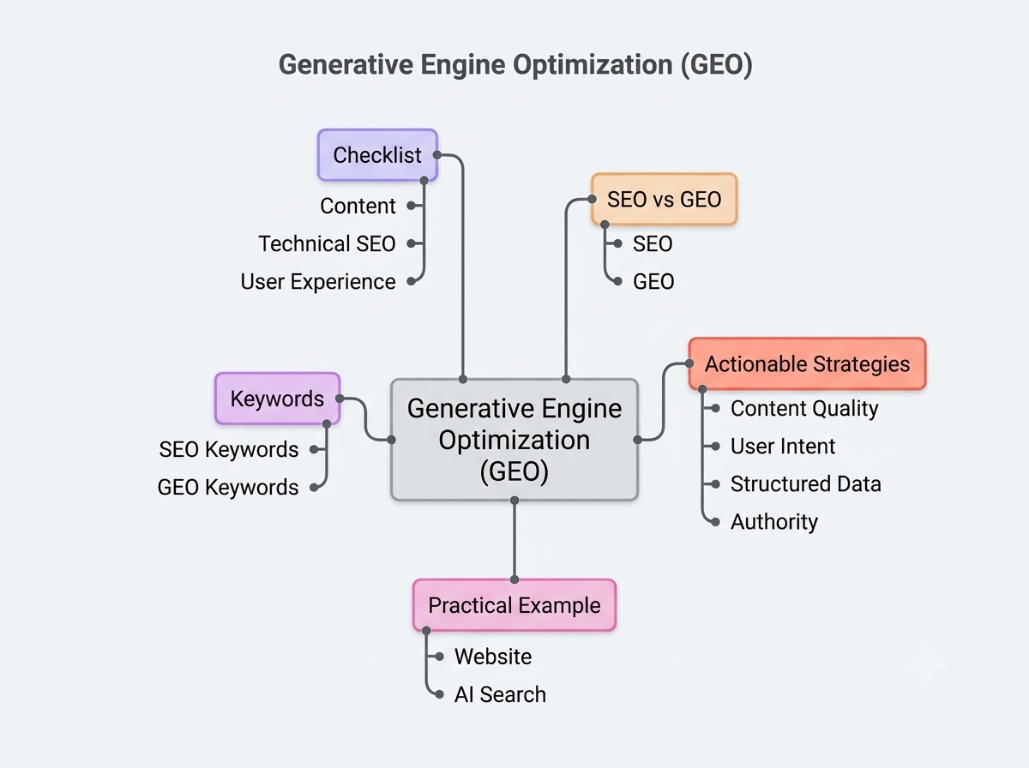
For years, digital marketers focused on getting websites onto the first page of Google. Keywords, backlinks, technical SEO, meta descriptions, and search rankings were important parts of the process.
Today, people can also ask questions directly through AI-powered search and discovery tools such as Google AI Overviews, ChatGPT Search, and Perplexity. Instead of simply displaying a list of blue links, these platforms can provide summarized answers and, in many cases, reference the sources used.
This creates a new opportunity and challenge for website owners and digital marketers.
Ranking well in traditional search is still important, but it is no longer the only consideration. Your content should also be clear, useful, well-structured, and easy for AI-powered search systems to understand.
This is where Generative Engine Optimization (GEO) comes in.
What Is Generative Engine Optimization (GEO)?
Generative Engine Optimization (GEO) is the practice of creating and structuring online content so that AI-powered search and answer engines can better understand the information and potentially use or cite it in their responses.
Traditional SEO focuses on helping search engines understand your website, match content with search intent, and determine relevance and authority.
GEO applies similar principles to AI-powered search environments, with greater emphasis on clear answers, natural language, contextual relevance, useful structure, and trustworthy information.
GEO does not replace SEO. Instead, it can be viewed as an additional approach to consider as search continues to evolve.
SEO vs GEO: What’s the Difference?
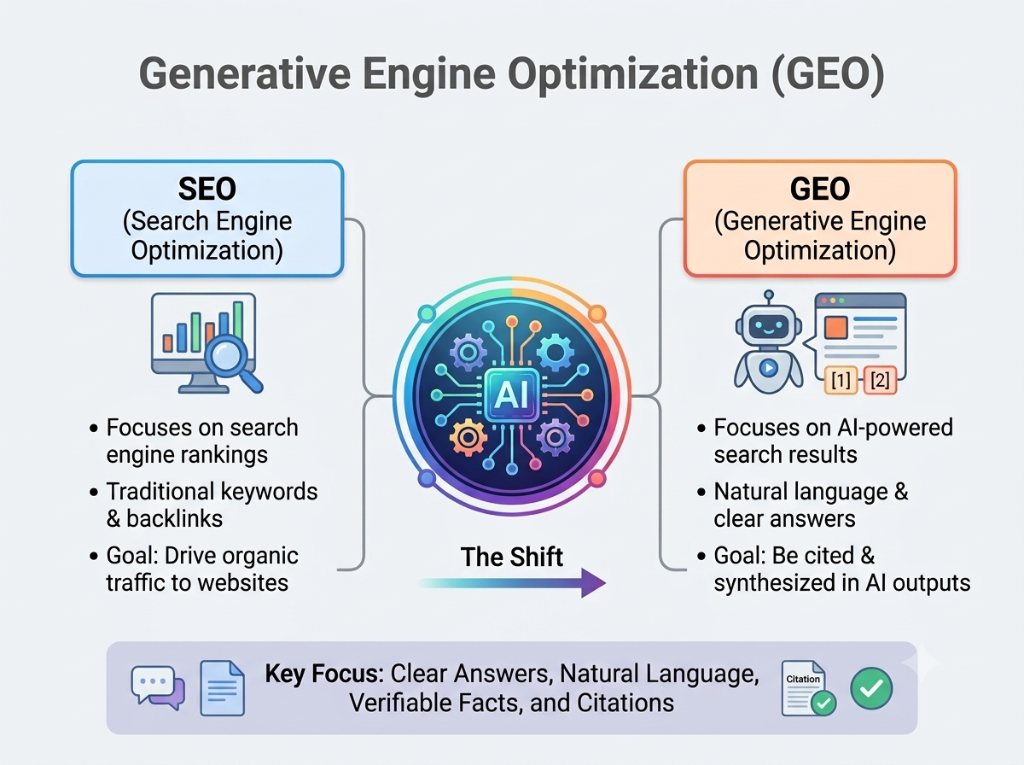
| Traditional SEO | GEO |
|---|---|
| Focuses on search engine visibility | Focuses on visibility within AI-generated answers |
| Targets keywords and search intent | Targets questions, context, and conversational intent |
| Helps search engines understand webpages | Makes information easier for AI systems to interpret |
| Builds authority through quality content and links | Emphasizes clear, trustworthy, well-supported information |
| Aims for strong search rankings | Aims to increase the chance of being referenced or cited |
The two approaches work best together. You don’t have to choose between SEO and GEO.
4 Actionable Strategies to Transition from SEO to GEO
If you want your content to have a better chance of appearing in AI-generated answers, start by thinking about how clearly your information is presented.
Here are four practical strategies to get started.
1. Use Direct Summary Blocks
AI-powered search systems need to understand the main point of a page quickly. Readers also appreciate getting a clear answer before going into the details.
How to do it: Start important sections with a short two- or three-sentence answer that directly addresses the question.
For example:
Generative Engine Optimization (GEO) is the process of creating content that is clear, structured, relevant, and easy for AI-powered search systems to understand and potentially reference.
You can then explain the topic in more detail below it.
This approach makes your content easier for both readers and search systems to understand.
2. Optimize for Natural-Language and Question-Based H2s
The way people ask questions has changed.
Instead of typing a short phrase such as:
“Best email marketing tools”
a user might ask:
“What is the best email marketing platform for a small e-commerce business with fewer than 10,000 subscribers?”
Conversational searches like these are especially relevant to AI-powered search experiences.
How to do it: Use H2s and H3s that reflect the actual questions your audience may have. Then answer the question clearly before expanding on the topic.
For example:
Instead of:
Best Email Marketing Tools
Try:
What Is the Best Email Marketing Tool for a Small Business?
The second version gives the reader clearer context about what the section is answering.
3. Use Relevant Structured Data and Schema Markup
Search engines use structured data to better understand information presented on a webpage.
Schema markup can provide additional context about elements such as articles, products, organizations, events, and other types of content.
How to do it: Use the appropriate structured-data type for your content rather than adding schema simply for the sake of adding it.
For example, an article can use Article structured data, while other eligible content may use relevant structured-data types.
Keep in mind that structured data does not guarantee higher rankings or inclusion in AI-generated answers. Its main purpose is to provide clearer machine-readable information about your content.
4. Build Verifiable Topical Authority and E-E-A-T
If you want your website to become a trusted source, publishing one random article after another isn’t enough.
Think about the bigger picture.
If your website focuses on digital marketing, you could build connected content around topics such as SEO, paid advertising, content marketing, social media, analytics, and conversion optimization.
How to do it: Create content clusters around important topics and connect related articles through internal links.
For example, you could create a main guide about Digital Marketing, supported by detailed articles about:
- SEO
- Google Ads
- Meta Ads
- Content Marketing
- Social Media Marketing
- Google Analytics
- Conversion Rate Optimization
Where possible, support your claims with reliable sources, current data, examples, and original insights. Also make your author information clear so readers can understand who created the content.
This helps build a website that feels useful and trustworthy rather than simply being a collection of keyword-focused articles.
A Practical Example of GEO
Imagine you run a digital marketing agency.
Instead of creating a general article titled “SEO Services,” you could create useful content around questions your potential customers actually ask, such as:
- How much do SEO services cost for a small business?
- What should a business check before hiring an SEO agency?
- How long does SEO take to show results?
- What is the difference between local SEO and traditional SEO?
Answer each question clearly, provide examples where useful, and link to related resources on your website.
This creates content that is more useful to your audience while giving search and AI systems clearer context about the subject you cover.
Key SEO & GEO Keywords to Target
If you want to improve your visibility in traditional search as well as AI-powered search experiences, use relevant keywords naturally rather than forcing them into every paragraph.
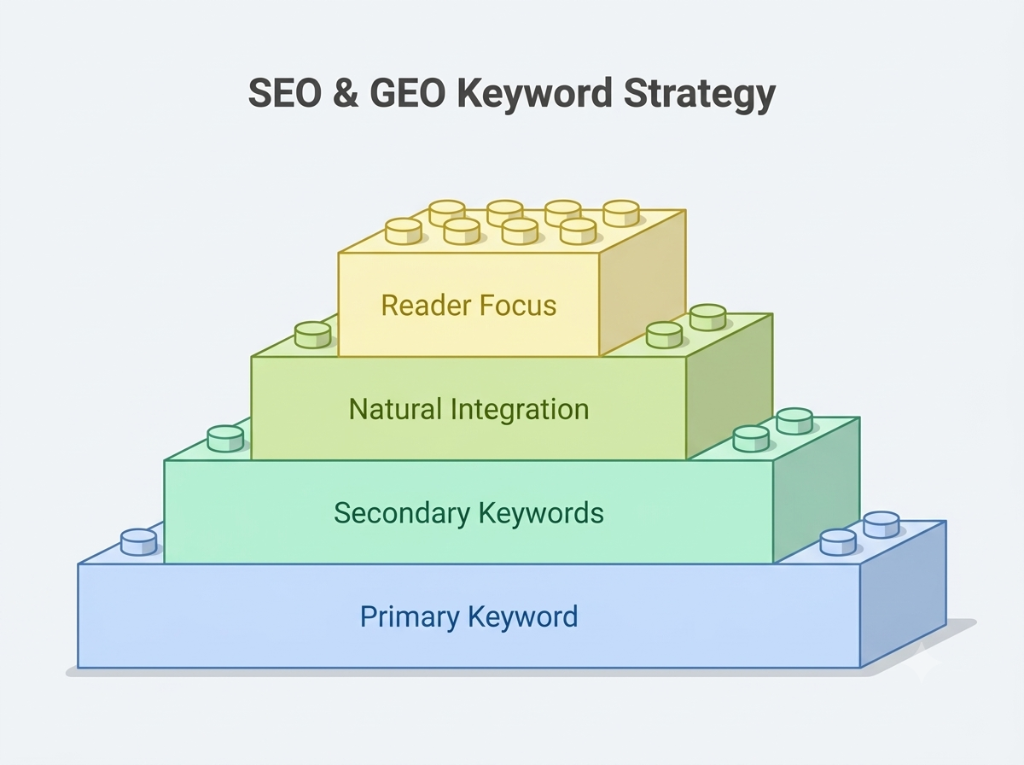
Primary Keyword
Generative Engine Optimization
Secondary Keywords
- GEO strategy
- AI search optimization
- AI search visibility
- Generative Engine Optimization GEO
- SEO and AI
- future of SEO
- answer engine optimization
- GEO for digital marketing
The goal should not be to repeat these phrases unnecessarily. Instead, use them where they genuinely fit the topic and help answer the reader’s question.
A Simple GEO Checklist for Your Next Blog
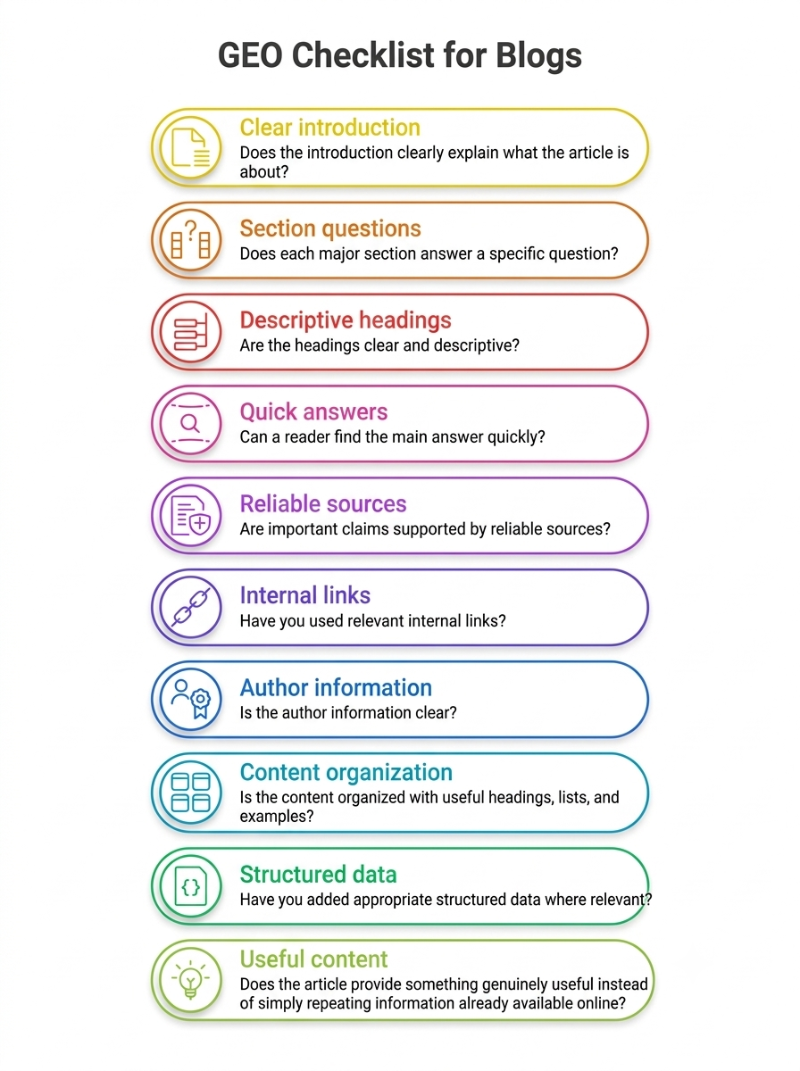
Before publishing your next article, ask yourself:
- Does the introduction clearly explain what the article is about?
- Does each major section answer a specific question?
- Are the headings clear and descriptive?
- Can a reader find the main answer quickly?
- Are important claims supported by reliable sources?
- Have you used relevant internal links?
- Is the author information clear?
- Is the content organized with useful headings, lists, and examples?
- Have you added appropriate structured data where relevant?
- Does the article provide something genuinely useful instead of simply repeating information already available online?
Final Thoughts
Traditional SEO is not dead. It is evolving alongside the way people discover information.
As AI-powered search becomes a bigger part of the online experience, digital marketers need to think beyond rankings alone. Clear answers, natural language, useful structure, trustworthy information, and strong topical coverage can all contribute to making content easier to understand and more useful in modern search environments.
The goal of GEO shouldn’t simply be to “get mentioned by AI.”
The real goal is to create content that is so clear, useful, and trustworthy that both people and search systems can understand its value.
SEO helps your content compete in traditional search. GEO helps you prepare that content for the way people are increasingly discovering information today.