
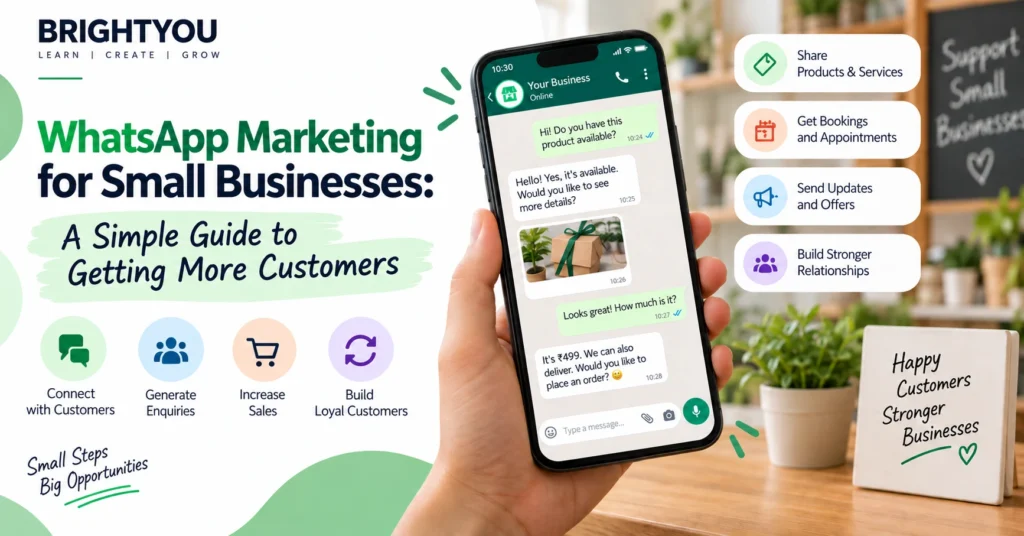
For many small businesses, WhatsApp is already part of everyday communication.
Customers use it to ask questions, check prices, make enquiries, book appointments, and sometimes even place orders.
But there is a difference between using WhatsApp to reply to customers and using it as part of your marketing strategy.
That’s where WhatsApp marketing for small businesses can make a difference.
You don’t need a huge advertising budget or a complicated marketing system to get started. With a simple approach, WhatsApp can help you turn conversations into enquiries, follow up with interested customers, promote your products or services, and stay connected with existing customers.
The key isn’t to send more messages.
It’s to send the right message to the right customer at the right time.
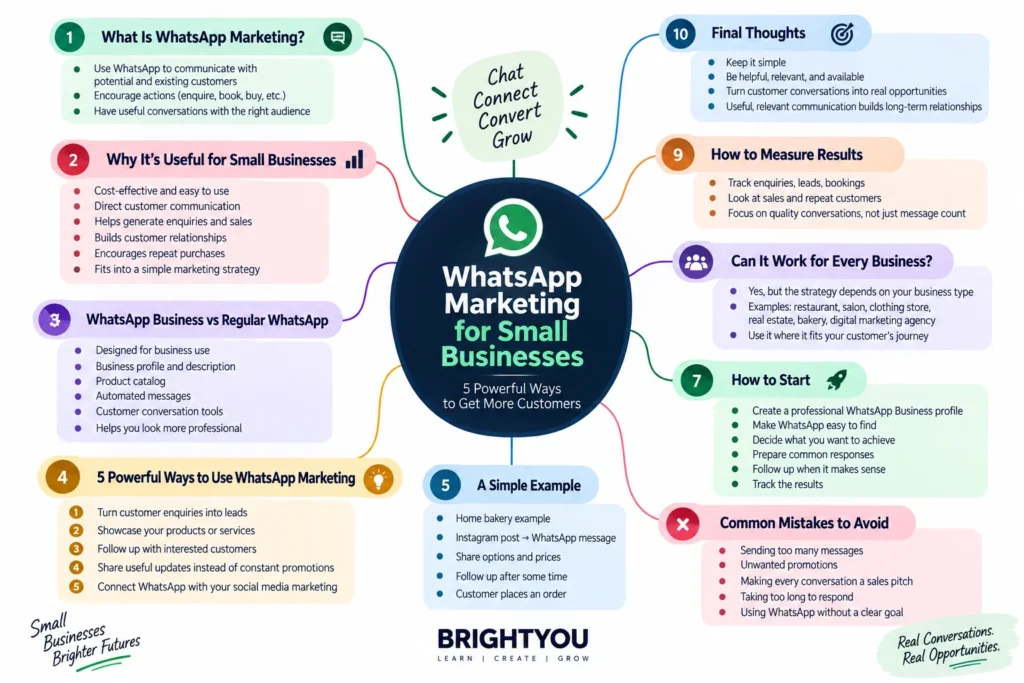
What Is WhatsApp Marketing?
In simple terms, WhatsApp marketing means using WhatsApp to communicate with potential and existing customers as part of your business and marketing activities.
The goal could be to encourage a customer to:
- Ask for more information
- Request a price
- Book an appointment
- Visit your business
- Buy a product
- Use a service
- Make another purchase
For example, imagine a salon has a weekend hair-care package.
Instead of simply sending an advertisement, the business could send an appropriate message to an interested customer:
“Hi! We have a weekend hair-care package available. Would you like us to send you the details?”
That’s WhatsApp marketing in a simple form.
The conversation feels more personal because the customer can ask questions and get an answer directly.
The goal isn’t to send as many messages as possible. It’s to have useful conversations with people who are genuinely interested in your business.
Why Is WhatsApp Marketing Useful for Small Businesses?
Small businesses often have limited budgets, small teams, and not enough time to manage complicated marketing campaigns.
WhatsApp can fit naturally into a simpler marketing strategy.
A business can use it to:
- Answer customer questions
- Follow up with potential customers
- Share products and services
- Confirm bookings
- Send important updates
- Provide customer support
- Build customer relationships
- Encourage repeat purchases
For example, a customer might discover a clothing store through Instagram. They may then send a WhatsApp message to ask whether a particular size is available.
The business replies, answers the question, and shares the relevant details.
The customer then decides to visit the store or place an order.
The journey could look like this:
Discover → Enquire → Chat → Follow Up → Purchase → Return
WhatsApp doesn’t have to do everything by itself. It can simply become one part of your overall digital marketing strategy.
WhatsApp Business vs Regular WhatsApp
If you’re using WhatsApp for your business, WhatsApp Business is designed specifically for business communication.
It provides business-focused features that can help you present your business more professionally and manage customer conversations.
Depending on the product and setup, features can include:
- Business profile
- Business description
- Product catalog
- Automated messages
- Business information
- Customer conversation tools
You can learn more about the official features on WhatsApp Business.
A professional business profile should clearly communicate basic information such as what you offer, where you operate, your website, and your business hours where relevant.
This makes it easier for customers to understand your business without having to ask basic questions.
5 Powerful Ways to Use WhatsApp Marketing
1. Turn Customer Enquiries Into Leads
One of the simplest ways to use WhatsApp is to make it easy for interested people to start a conversation.
You might add a simple call to action such as:
“Have a question? Chat with us on WhatsApp.”
Someone who takes the time to message you has already shown some interest.
Instead of immediately trying to sell something, start by understanding what they need.
For example, if you run a digital marketing agency, someone might ask:
“How much does SEO cost?”
Rather than sending a generic sales message, you can ask what type of business they have and what they are trying to achieve.
This creates a more useful conversation and gives you a better understanding of what the customer actually needs.
For businesses where customers usually have questions before buying, WhatsApp can be a convenient way to handle those enquiries.
2. Showcase Your Products or Services
If you sell products, WhatsApp Business can provide tools for presenting your offerings to customers.
A product catalog, where available, can help customers browse information such as:
- Product name
- Product image
- Price
- Description
- Other relevant details
Service-based businesses can also use WhatsApp conversations to explain their packages and services.
For example, a salon could explain different hair-care packages, while a home bakery could share cake options, flavours, sizes, and prices.
This can save time because you don’t have to manually type the same basic information every time someone asks.
You can also direct customers to your website when they need more detailed information.
3. Follow Up With Interested Customers
Not every customer is ready to buy immediately.
Someone might ask about your price today and need a few days to think about it.
That’s completely normal.
A polite follow-up can bring the conversation back without putting unnecessary pressure on the customer.
For example:
“Hi, just checking if you had a chance to look at the details. Let me know if you’d like any help.”
That’s very different from repeatedly sending:
“Buy now!”
Good follow-up should feel helpful rather than pushy.
Before sending a message, ask yourself:
“Would this message actually be useful to this customer?”
If the answer is yes, send it.
4. Share Useful Updates Instead of Constant Promotions
WhatsApp marketing doesn’t mean sending advertisements all the time.
If every message is a promotion, people may eventually stop paying attention.
Instead, think about what your customers would genuinely find useful.
Depending on your business, this could include:
- New products
- Helpful tips
- Seasonal updates
- Appointment reminders
- Product availability
- Important announcements
- Relevant offers
For example, a bakery could send an update about a new festive collection.
A salon could remind a customer about an upcoming appointment.
A clothing store could let interested customers know that a previously unavailable product is back in stock.
The message should have a clear reason for being sent.
Useful communication builds a better relationship than constant selling.
5. Connect WhatsApp With Your Social Media Marketing
WhatsApp can work particularly well alongside platforms such as Instagram and Facebook.
Think about a simple customer journey:
Instagram Post → WhatsApp Message → Conversation → Follow-Up → Customer
For example, a clothing business might post a new collection on Instagram and give interested customers a way to ask questions through WhatsApp.
Someone sees the post and sends a message:
“Do you have this in medium?”
The business responds and provides the information.
That social media post has now become more than just content. It has started a direct customer conversation.
You can learn more about Meta’s business tools through Meta for Business.
For more digital marketing ideas, you can also explore BrightYou’s Digital Marketing Services.
A Simple WhatsApp Marketing Example
Let’s imagine a small home bakery.
The bakery posts a picture of a birthday cake on Instagram with a simple message:
“Planning a birthday? Message us on WhatsApp for flavours and prices.”
A customer sees the post and sends a message.
They ask about the available flavours.
The bakery replies with the options and prices.
The customer is interested but doesn’t place an order immediately.
A few days later, the bakery sends a polite follow-up.
The customer confirms the order.
Nothing complicated happened.
The journey was simply:
Content → Conversation → Follow-Up → Purchase
This is one of the useful things about WhatsApp for a small business. It can connect marketing activity with direct customer communication.
Common WhatsApp Marketing Mistakes to Avoid
WhatsApp can be useful, but the way you use it matters.
Sending Too Many Messages
Messaging customers repeatedly can quickly become annoying.
Don’t send something just because you haven’t contacted someone recently.
Have a genuine reason for each message.
Sending Unwanted Promotions
Not every customer wants promotional messages.
Respect customer preferences and applicable messaging requirements. Communicate appropriately and provide suitable ways for customers to manage marketing communications.
Making Every Conversation a Sales Pitch
Sometimes customers simply need information.
If someone asks a question, answer it clearly instead of immediately turning the conversation into a sales pitch.
Helping someone today can create trust that matters later.
Taking Too Long to Respond
WhatsApp is a direct communication channel, so customers often expect a reasonably timely response.
If your business receives many messages, create a simple process for handling enquiries so that genuine customers don’t get overlooked.
Using WhatsApp Without a Clear Goal
Before starting WhatsApp marketing, decide what you want it to achieve.
Is your goal:
More enquiries?
More bookings?
More sales?
Better customer support?
More repeat purchases?
A clear goal makes it easier to measure whether your efforts are actually working.
How to Start WhatsApp Marketing for Your Small Business
You don’t need to build a complicated system on day one.
Start with a few simple steps.
1. Create a professional WhatsApp Business profile
Add your business name, description, category, website, and other relevant information.
2. Make WhatsApp easy to find
Add your WhatsApp contact option to your website, social media profiles, and other appropriate marketing channels.
3. Decide what you want to achieve
Choose one main goal first, such as generating more enquiries or increasing bookings.
4. Create a simple response process
Think about the questions customers ask most often and prepare clear answers.
5. Follow up when it makes sense
If someone has shown genuine interest, a helpful follow-up can keep the conversation moving.
6. Track the results
Don’t only count the number of WhatsApp messages.
Look at the full journey:
Messages → Enquiries → Leads → Customers
This gives you a better idea of whether WhatsApp is contributing to your business.
Can WhatsApp Marketing Work for Every Business?
WhatsApp can be useful for many types of businesses, but the strategy will depend on what you sell and how your customers make decisions.
A restaurant might use it for orders or reservations.
A salon might use it for appointment bookings.
A clothing store might use it for product enquiries.
A real estate business might use it for property enquiries.
A home bakery might use it to discuss custom orders.
A digital marketing agency might use it for consultations and lead follow-ups.
The important thing is to understand where WhatsApp fits into your customer’s buying journey.
You don’t need to force WhatsApp into every part of your marketing.
Use it where direct communication actually helps.
How to Measure WhatsApp Marketing
Once you start using WhatsApp for business, pay attention to what happens after people send a message.
Useful metrics can include:
- Number of enquiries
- Qualified leads
- Bookings
- Orders
- Sales
- Follow-up responses
- Repeat customers
For example, getting 100 messages isn’t necessarily better than getting 30.
If those 30 conversations result in more qualified enquiries and customers, they may be more valuable to the business.
This is why it’s better to focus on quality conversations and outcomes rather than simply chasing a high message count.
Frequently Asked Questions
Is WhatsApp marketing useful for small businesses?
Yes. It can help small businesses communicate with customers, handle enquiries, share products or services, follow up with leads, and maintain relationships with existing customers.
Is WhatsApp Business free?
WhatsApp offers a business app designed for small businesses. Other WhatsApp business and messaging solutions may have different features or pricing, so check the official WhatsApp Business information for the latest details.
Can WhatsApp marketing generate leads?
Yes. Businesses can use WhatsApp as a contact channel from their website, social media, and other marketing activities. Interested people can start conversations that may become qualified leads.
How often should a business send WhatsApp marketing messages?
There is no universal number that works for every business. Focus on relevance rather than frequency. Send messages when you have something useful to communicate and respect customer preferences.
Can WhatsApp replace social media marketing?
Not really. WhatsApp and social media serve different purposes. Social platforms can help people discover your business, while WhatsApp provides a more direct way to communicate with interested customers.
Final Thoughts
WhatsApp marketing for small businesses doesn’t have to be complicated.
You don’t need a huge customer database or an expensive marketing system to get started.
Begin with the basics.
Create a professional WhatsApp Business profile. Make it easy for customers to contact you. Respond clearly to enquiries. Follow up when appropriate. Share useful information instead of constantly promoting your products.
Most importantly, remember that WhatsApp is a conversation channel.
People don’t want to feel like they’re talking to an advertisement.
They want quick answers, useful information, and a business that understands what they need.
When you use WhatsApp with that mindset, it can become a valuable part of your digital marketing strategy.
Good marketing isn’t about sending the most messages. It’s about being useful, relevant, and available when your customers need you.
Related Reading
Digital Marketing for Small Businesses in Kerala: A Simple Guide to Growing Online
Generative Engine Optimization (GEO): How to Optimize Your Website for AI Search
Read the GEO article on BrightYou