
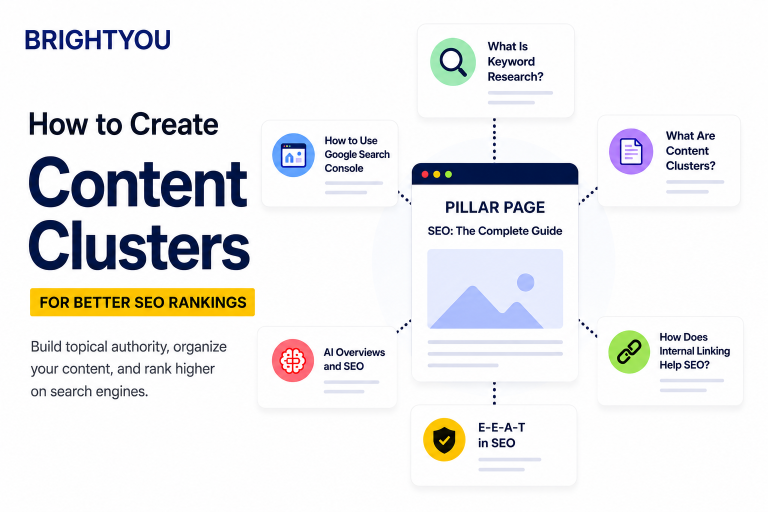
A content cluster strategy organizes related content around a central topic. Instead of publishing random articles, you create a group of interconnected pages covering a subject in depth.
For example, if your website focuses on digital marketing, you might create content about SEO, Google Search Console, keyword research, AI search, and other related topics. When these articles are strategically connected through internal links, they form a content cluster.
In this guide, you’ll learn what content clusters are, why they matter for SEO, and how to create a successful content cluster strategy for your website.
What Is a Content Cluster?
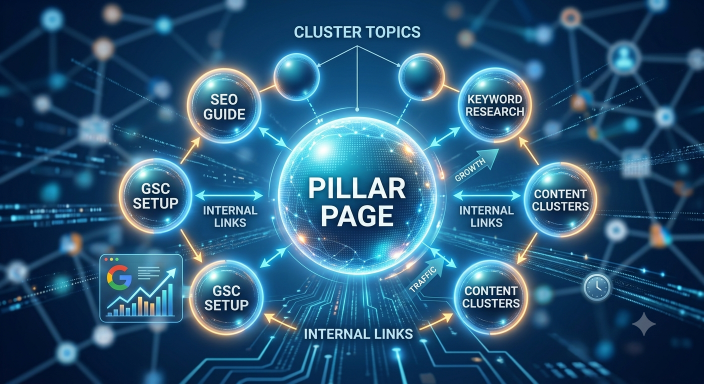
A content cluster, also known as a topic cluster, is a group of related content pieces organized around a broad subject.
A typical content cluster has three important components:
- Pillar page: A comprehensive guide covering a broad topic.
- Cluster content: Individual articles that explore specific subtopics in greater detail.
- Internal links: Links that connect the pillar page and related cluster articles.
Visualizing a Content Cluster
                        ┌────────────────────────┐
                        │       PILLAR PAGE      │
                        │   Complete SEO Guide   │
                        └───────────┬────────────┘
                                    │
           ┌────────────────────────┼────────────────────────┐
           │                        │                        │
  ┌────────┴─────────┐     ┌────────┴─────────┐     ┌────────┴─────────┐
  │ Cluster Article  │     │ Cluster Article  │     │ Cluster Article  │
  │ Keyword Research │<--->│ Google Search    │<--->│ Content Clusters │
  │ Guide            │     │ Console Setup    │     │ Strategy         │
  └──────────────────┘     └──────────────────┘     └──────────────────┘
Example of a Content Cluster
Imagine that your main topic is SEO.
Your content structure could look like this:
Pillar Topic: SEO
Related cluster articles:
- What Is Keyword Research?
- How to Use Google Search Console
- What Are Content Clusters?
- How Does Internal Linking Help SEO?
- E-E-A-T in SEO
- AI Overviews and SEO
All these articles are connected because they relate to the broader subject of SEO.
Why Are Content Clusters Important for SEO?
Content clusters can improve the organization of your website and help you create a stronger content strategy.
1. They Help Build Topical Authority
Publishing multiple high-quality articles about related subjects helps demonstrate that your website covers a topic in depth.
For example, writing just one article about SEO may provide limited topical coverage. However, creating useful content about keyword research, technical SEO, content strategy, Google Search Console, and AI search creates a more comprehensive resource.
Google’s guidance emphasizes creating helpful, people-first content rather than content created simply to manipulate search rankings. A well-planned content strategy can help you provide comprehensive information to your audience.
Learn more from Google’s official guidance on creating helpful, reliable, people-first content.
2. They Improve Internal Linking
Internal links connect different pages on your website.
A strong content cluster uses internal links to help visitors discover additional relevant information.
For example, in an article about content clusters, you could link to:
- Your guide about GEO for websites
- Your article about E-E-A-T and SEO
- A future guide about Google Search Console
These connections can create a clearer website structure.
3. They Improve the User Experience
Visitors often have multiple questions about a topic.
For example, someone learning about SEO may also want to know:
- How do I find keywords?
- How do I track website performance?
- What is E-E-A-T?
- How does AI affect search?
Content clusters make it easier for users to continue exploring related information.
4. They Help You Plan Future Content
One of the biggest advantages of a content cluster strategy is that you don’t have to randomly search for new blog ideas every time you publish.
Once you select a broad topic, you can identify multiple related subtopics.
This creates a structured content plan for the future.
Pillar Pages vs Cluster Pages
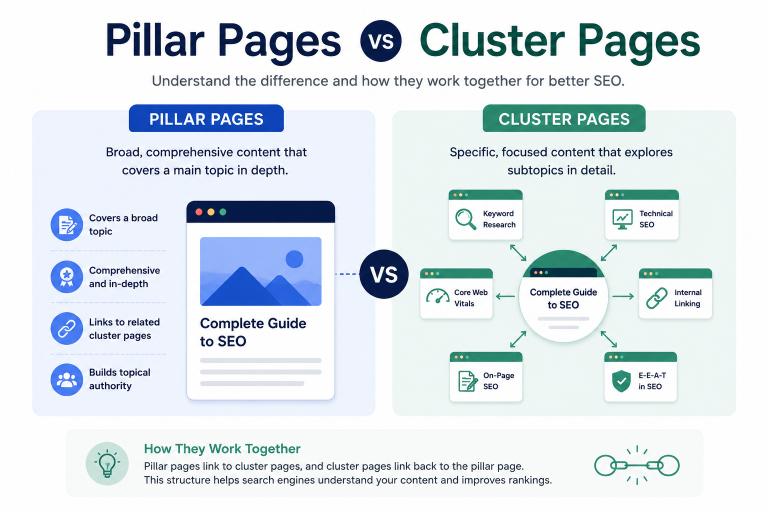
Understanding the difference between pillar content and cluster content is important.
What Is a Pillar Page?
A pillar page is a comprehensive piece of content covering a broad subject.
For example:
Pillar Page:
The Complete Guide to SEO
The page could introduce several important areas of SEO without going into excessive detail about every individual topic.
What Is Cluster Content?
Cluster content focuses on a specific part of the broader topic.
Examples include:
- How to Perform Keyword Research
- How to Use Google Search Console
- What Is Technical SEO?
- How to Create Content Clusters
- How AI Overviews Affect SEO
Each cluster article should explore its specific topic in greater depth.
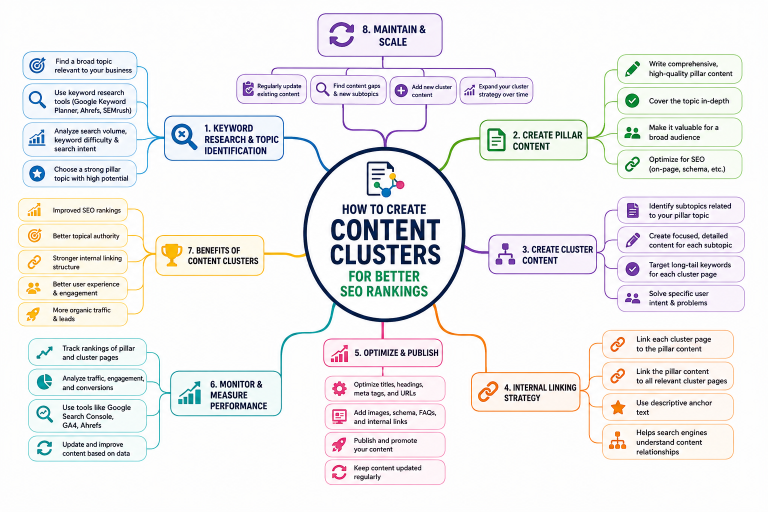
How to Create a Content Cluster Step by Step
Now, let’s look at how you can build a content cluster for your website.
Step 1: Choose a Broad Topic
Start by selecting a broad topic that is relevant to your business and audience.
For a digital marketing website such as BrightYou, potential broad topics include:
- Search Engine Optimization
- Social Media Marketing
- Google Ads
- Content Marketing
- Analytics
- Artificial Intelligence in Marketing
Choose a topic that gives you enough opportunities to create multiple useful articles.
For example, SEO is broad enough to support many related topics.
Step 2: Identify Your Audience’s Questions
The next step is identifying what your target audience wants to know.
Think about the questions beginners, business owners, or potential customers may ask.
For SEO, these questions might include:
- What is SEO?
- How do I choose SEO keywords?
- How do I improve website rankings?
- How do I use Google Search Console?
- What are content clusters?
- How is AI changing SEO?
You can use tools such as:
- Google Search
- Google Search Console
- Google Keyword Planner
- People Also Ask
- Keyword research tools
Google Search Console can be particularly valuable because it shows the queries for which your website is already receiving impressions.
Step 3: Create a Pillar Topic
After identifying your broad subject, create a central pillar topic.
For example:
Pillar Topic: SEO Guide for Beginners
This pillar page could provide an overview of:
- Keyword research
- On-page SEO
- Technical SEO
- Content strategy
- Internal linking
- Search performance tracking
You can then link from this page to more detailed articles about each topic.
Step 4: Find Related Cluster Topics
Next, identify smaller topics related to your pillar page.
For an SEO content cluster, your structure could look like this:
SEO Pillar Page
Cluster Articles:
- How to Perform Keyword Research for SEO
- What Is On-Page SEO?
- How to Create Content Clusters for Better SEO Rankings
- How to Use Google Search Console to Improve Your Website SEO
- E-E-A-T in SEO: How to Build Trust in the Age of AI Content
- AI Overviews and SEO: How to Optimize Your Content
- A Beginner’s Guide to Internal Linking
This structure provides a clear roadmap for future content.
Step 5: Create High-Quality Content for Each Topic
Simply publishing many articles is not enough.
Every article should provide useful, accurate, and relevant information.
When creating content, consider:
- What problem does the reader want to solve?
- Does the article answer their main questions?
- Is the information easy to understand?
- Does the content provide practical value?
- Are there relevant examples?
Avoid creating multiple articles that say exactly the same thing.
Each article should have a unique purpose within the content cluster.
Step 6: Connect Your Content With Internal Links
Internal linking is one of the most important parts of a content cluster strategy.
For example, this article could link to your future article:
How to Use Google Search Console to Improve Your Website SEO
That article could then link back to this content-cluster guide.
Similarly, your article about E-E-A-T in SEO could link to both your GEO content and other relevant SEO resources.
The goal is to create natural connections between related topics.
However, avoid adding internal links randomly. Every link should provide additional value to the reader.
Google also provides information about how links can help users and search engines understand your site.
Step 7: Monitor Your Content Performance
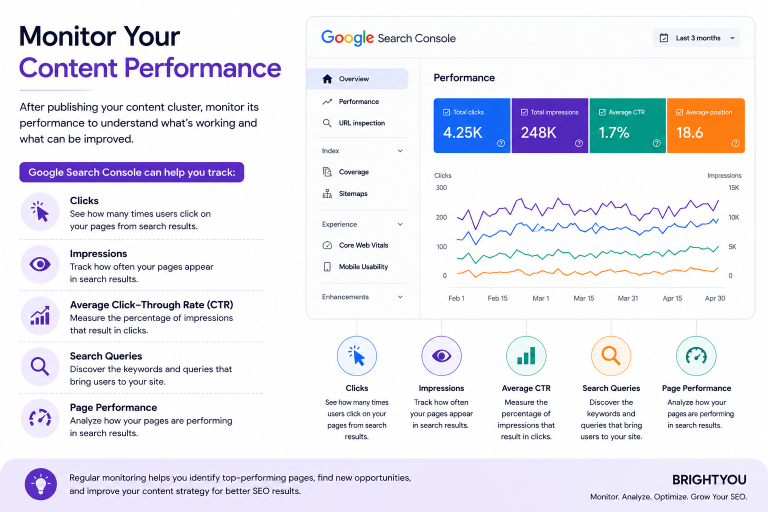
After publishing your content cluster, monitor its performance.
Google Search Console can help you track:
- Clicks
- Impressions
- Average click-through rate
- Search queries
- Page performance
This information can help you discover which topics are gaining visibility.
For example, if your website begins receiving impressions for a particular keyword but has few clicks, you may be able to improve the article’s title, meta description, or content.
You can also identify new content opportunities from queries your website is already appearing for.
Example: A Content Cluster Strategy for BrightYou
BrightYou can gradually build topical authority around digital marketing by creating multiple related clusters.
Cluster 1: SEO
Possible articles:
- How to Get Started with GEO for Your Website
- E-E-A-T in SEO: How to Build Trust in the Age of AI Content
- How to Create Content Clusters for Better SEO Rankings
- How to Use Google Search Console to Improve Your Website SEO
- AI Overviews and SEO
Cluster 2: Social Media Marketing
Possible articles:
- Instagram Reels vs Posts: Which Is Better for Your Business?
- How to Create a Social Media Content Strategy
- How Small Businesses Can Use Instagram for Marketing
- Social Media Metrics Every Business Should Track
Cluster 3: Website Analytics
Possible articles:
- A Practical Guide to Tracking User Journeys in GA4
- Important GA4 Metrics for Beginners
- How to Track Website Events Using Google Tag Manager
Over time, these content clusters can help BrightYou develop a well-organized content library.
Common Content Cluster Mistakes to Avoid
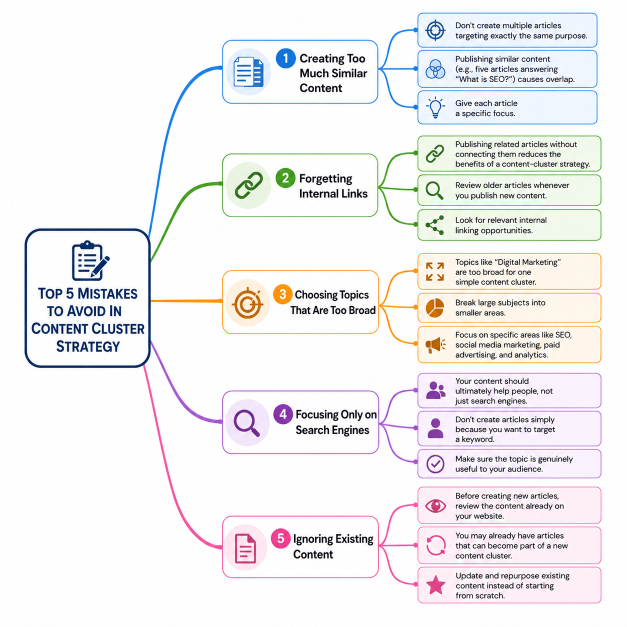
1. Creating Too Much Similar Content
Do not create multiple articles targeting exactly the same purpose.
For example, publishing five articles that all answer “What is SEO?” may create unnecessary overlap.
Instead, give each article a specific focus.
2. Forgetting Internal Links
Publishing related articles without connecting them reduces the benefits of a content-cluster strategy.
Review your older articles whenever you publish new content and look for relevant internal linking opportunities.
3. Choosing Topics That Are Too Broad
A topic such as “Digital Marketing” may be too broad for one simple content cluster.
Break large subjects into smaller areas such as SEO, social media marketing, paid advertising, and analytics.
4. Focusing Only on Search Engines
Your content should ultimately help people.
Don’t create articles simply because you want to target a keyword. Make sure the topic is genuinely useful to your audience.
5. Ignoring Existing Content
Before creating new articles, review the content already on your website.
You may already have articles that can become part of a new content cluster.
How Long Does It Take for Content Clusters to Improve SEO?
There is no guaranteed timeline.
SEO results depend on many factors, including:
- Website authority
- Content quality
- Competition
- Search demand
- Technical SEO
- Internal linking
- How well the content meets user needs
Content clusters should be considered a long-term strategy rather than a quick way to achieve rankings.
Continue creating useful content, updating older articles, and improving your website structure over time.
Frequently Asked Questions About Content Clusters
What is a content cluster in SEO?
A content cluster is a group of related articles organized around a central topic and connected through internal links.
What is the difference between a pillar page and a cluster page?
A pillar page broadly covers a major topic, while cluster pages explore specific subtopics in greater detail.
Do content clusters improve SEO?
Content clusters can improve website organization, internal linking, topical coverage, and the user experience. However, they do not guarantee specific rankings.
How many articles should be in a content cluster?
There is no fixed number. Start with several highly relevant articles and expand the cluster when you identify useful topics for your audience.
Can an existing blog become part of a content cluster?
Yes. You can review your existing articles, organize related content around a central topic, and add relevant internal links.
Final Thoughts
A successful SEO strategy is not about publishing as many random blog posts as possible. It is about creating helpful content that connects naturally and answers your audience’s questions.
Content clusters provide a structured way to organize your website’s content around important topics.
Start by selecting a broad subject, identify the questions your audience is asking, create detailed content around those topics, and connect relevant articles through internal links.
For BrightYou, building clusters around SEO, AI in search, social media marketing, and website analytics can create a strong foundation for future growth.
Ready to Improve Your Digital Marketing Strategy?
Explore more digital marketing guides on BrightYou and learn how SEO, AI, content marketing, analytics, and social media can help businesses build a stronger online presence