
Artificial intelligence has changed the way businesses create content.
Today, AI tools can help write blog posts, generate ideas, conduct research, and improve productivity within minutes. However, this has also created a major challenge: how can readers and search engines determine which content is genuinely useful and trustworthy?
This is where E-E-A-T in SEO becomes important.
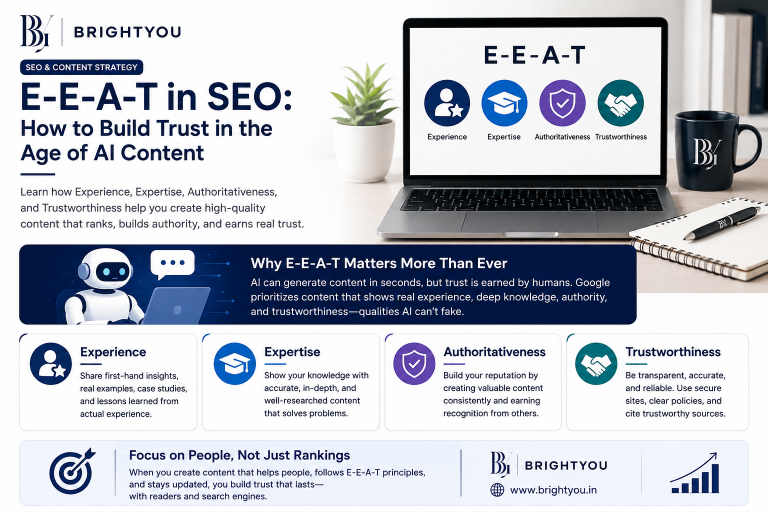
E-E-A-T represents Experience, Expertise, Authoritativeness, and Trustworthiness. These qualities help website owners focus on creating content that provides real value instead of simply producing large amounts of information.
In the age of AI-generated content, building trust may be more important than ever.
Let’s explore what E-E-A-T means and how you can apply it to your website.
What Is E-E-A-T in SEO?
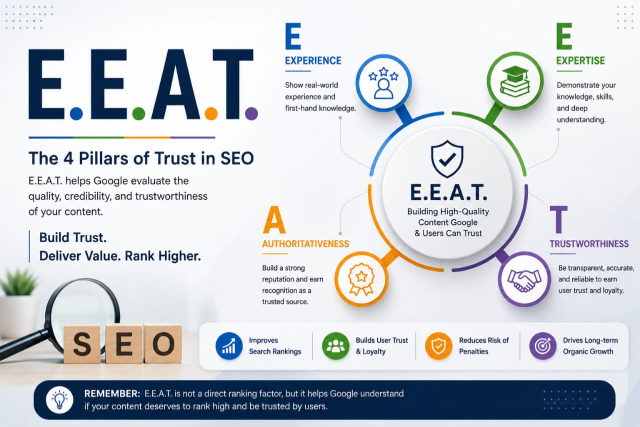
E-E-A-T stands for:
- Experience
- Expertise
- Authoritativeness
- Trustworthiness
The concept comes from Google’s Search Quality Rater Guidelines and is used to help evaluate the quality of information and websites.
It is important to understand that E-E-A-T is not a single ranking factor that can simply be switched on or off. Instead, it represents qualities associated with high-quality and trustworthy content.
Let’s look at each element.
Experience: Demonstrating First-Hand Knowledge
Experience refers to whether the content creator has genuine, first-hand knowledge of a topic.
For example, imagine you are reading a review of a digital marketing tool.
Which article would you trust more?
One that simply lists information copied from different websites, or one written by someone who has actually used the tool and explains their experience?
First-hand experience can make content more useful and credible.
You can demonstrate experience by:
- Sharing practical examples
- Including real-life observations
- Writing case studies
- Explaining challenges and solutions
- Adding original screenshots or images where relevant
- Sharing lessons learned from actual experience
For a digital marketing website, practical knowledge can make content significantly more valuable.
For example, instead of simply explaining what Google Search Console is, you could discuss how to use its data to identify content opportunities.
Expertise: Showing Knowledge of Your Subject
Expertise refers to the knowledge and understanding demonstrated in your content.
You do not need to use complicated language to demonstrate expertise. In fact, explaining complex subjects clearly can demonstrate a strong understanding of a topic.
For example, if you write about SEO, your content should demonstrate an understanding of concepts such as:
- Keyword research
- Search intent
- Technical SEO
- Content optimization
- Internal linking
- Website performance
However, it is also important to recognize your limits.
Do not present yourself as an expert in areas where you do not have sufficient knowledge. For sensitive subjects such as health, finance, or legal advice, accuracy and appropriate expertise are particularly important.
Ways to demonstrate expertise include:
- Conducting proper research
- Using reliable sources
- Explaining concepts accurately
- Keeping content updated
- Providing useful examples
- Having knowledgeable authors review important content
Authoritativeness: Building Recognition and Credibility
Authoritativeness is related to your reputation as a reliable source of information.
A website can gradually build authority by consistently publishing useful and accurate content within a particular subject area.
For example, imagine a website that regularly publishes high-quality content about:
- SEO
- Content marketing
- Social media marketing
- Google Ads
- Website analytics
Over time, readers may begin to recognize the website as a useful source of digital marketing information.
Authoritativeness can also be supported by relevant recognition from other reliable sources.
You can work towards building authority by:
- Creating high-quality content consistently
- Covering topics in depth
- Building topical relevance
- Earning relevant backlinks naturally
- Maintaining a professional online presence
- Providing accurate information
Authority is usually built over time. There is no quick shortcut.
Trustworthiness: The Most Important Element
Trust is an essential part of a successful website.
Visitors should feel confident that your content and website are reliable.
Trustworthiness can involve many factors, including:
- Accurate information
- Clear author information
- Transparent business details
- Secure website connections
- Accessible contact information
- Honest recommendations
- Clear privacy policies
If a website makes misleading claims or provides inaccurate information, readers may quickly lose confidence.
This is especially important in an era where large amounts of AI-generated content are published online every day.
Before publishing content, ask yourself:
Would a reader consider this information reliable?
If the answer is uncertain, review and improve the content.
Why Is E-E-A-T Important in the Age of AI Content?
AI has made content creation faster and easier.
However, it has also made it easier to create thousands of generic articles with little original value.
Simply generating a large number of blog posts is no longer a sustainable content strategy.
Readers are looking for content that provides:
- Accurate information
- Unique insights
- Real examples
- Clear explanations
- Reliable sources
This is where E-E-A-T can help guide your content strategy.
AI can assist with content creation, but it cannot automatically replace human experience, professional judgment, or genuine expertise.
The strongest approach is to use AI as a helpful tool while ensuring that humans review, improve, and add value to the final content.
How to Build E-E-A-T for Your Website
Building trust and credibility takes time, but you can start with some practical steps.
1. Create Helpful and Original Content
Avoid creating content solely to attract search traffic.
Instead, focus on answering real questions.
Before writing a blog, consider:
- Who is searching for this topic?
- What problem are they trying to solve?
- What information do they actually need?
- Can I provide something useful that other articles may not?
Original examples and practical insights can make your content more valuable.
2. Add Author and Website Information
Visitors should be able to understand who is responsible for the content on your website.
Consider creating:
- An About page
- An author bio
- A Contact page
- A Privacy Policy
- Other relevant business information
For example, an author bio can briefly explain the person’s background, knowledge, or experience related to the topic.
This provides additional context for readers.
3. Use Reliable Sources
When discussing important facts, statistics, or claims, link to reliable sources where appropriate.
For digital marketing content, useful sources may include official websites such as:
However, avoid adding external links simply for the sake of it.
Every source should provide genuine value to the reader.
4. Keep Your Content Updated
Outdated information can reduce trust.
This is particularly important in digital marketing because platforms, tools, and algorithms change frequently.
Regularly review your important content and update:
- Statistics
- Platform features
- Screenshots
- External links
- Recommendations
A well-maintained website demonstrates that you care about providing accurate information.
5. Share Real Examples Where Possible
Real examples can demonstrate experience and make complex information easier to understand.
For example, instead of simply writing:
Internal linking is important for SEO.
You could explain how connecting related articles helps visitors discover additional information on your website.
For BrightYou, related articles about SEO, GEO, and AI search can naturally link to one another.
Practical examples make information easier to understand and more useful.
6. Build a Clear Content Strategy
Publishing random and unrelated articles may make it difficult to build expertise around a particular subject.
Instead, consider creating content clusters.
For example, BrightYou could develop strong content categories around:
SEO and AI Search
- Generative Engine Optimization
- SEO strategies
- E-E-A-T
- Content optimization
- AI-powered search
Social Media Marketing
- Instagram marketing
- WhatsApp marketing
- Video marketing
- Social media strategies
Digital Advertising
- Google Ads
- Meta Ads
- Campaign strategies
- Performance tracking
Creating connected content can help readers explore a subject in greater depth.
Can You Use AI to Create E-E-A-T Content?
Yes, but AI should be used carefully.
AI can help with:
- Brainstorming ideas
- Creating outlines
- Improving grammar
- Summarizing information
- Generating content drafts
- Organizing information
However, AI-generated content should not be published without proper review.
Before publishing AI-assisted content:
- Check the facts.
- Correct inaccurate information.
- Add original insights.
- Include practical examples.
- Review the tone and readability.
- Add relevant sources where necessary.
The value comes from how you use AI, not simply from the fact that AI was used.
Common E-E-A-T Mistakes to Avoid
Publishing Content Without Fact-Checking
AI tools and online sources can sometimes provide inaccurate information.
Always verify important claims before publishing them.
Pretending to Have Experience
Never create false personal experiences or misleading case studies.
Authenticity is essential for building trust.
Creating Content Only for Search Engines
Keyword optimization is useful, but content should always prioritize people.
Write naturally and answer the reader’s question.
Ignoring Your Website’s Trust Pages
An About page, Contact page, and Privacy Policy can help visitors understand your website and business.
Make sure important information is easy to find.
Copying Content From Other Websites
Creating original content is essential.
Use other sources for research and inspiration, but do not copy their work.
A Simple E-E-A-T Checklist
Before publishing a new article, ask yourself:
Experience
- Does this article include practical knowledge or useful examples?
Expertise
- Is the information accurate and well-researched?
Authoritativeness
- Does this content contribute to my website’s knowledge in this subject?
Trustworthiness
- Are the claims honest and supported by reliable information?
If your answer is yes, you are moving in the right direction.
E-E-A-T and the Future of Content
As AI technology becomes increasingly accessible, the internet will continue to receive more automatically generated content.
This makes human insight and trust increasingly valuable.
The future of content marketing may not be about producing the highest number of articles. Instead, it may focus more on creating content that is:
- Helpful
- Accurate
- Original
- Easy to understand
- Based on genuine knowledge
- Regularly updated
For website owners, this means quality should remain a priority.
AI can make content creation more efficient, but human judgment is still essential.
Conclusion
E-E-A-T is an important concept for anyone creating content online.
By focusing on Experience, Expertise, Authoritativeness, and Trustworthiness, you can create a stronger foundation for your website.
You don’t need to become an industry leader overnight. Start with simple improvements.
Create helpful content. Share genuine knowledge. Check your facts. Use reliable sources. Be transparent about who you are.
In the age of AI-generated content, trust can become one of your website’s greatest strengths.
E-E-A-T in SEO: How to Build Trust in the Age of AI Content
Artificial intelligence has changed the way businesses create content.
Today, AI tools can help write blog posts, generate ideas, conduct research, and improve productivity within minutes. However, this has also created a major challenge: how can readers and search engines determine which content is genuinely useful and trustworthy?
This is where E-E-A-T in SEO becomes important.
E-E-A-T represents Experience, Expertise, Authoritativeness, and Trustworthiness. These qualities help website owners focus on creating content that provides real value instead of simply producing large amounts of information.
In the age of AI-generated content, building trust may be more important than ever.
Let’s explore what E-E-A-T means and how you can apply it to your website.
What Is E-E-A-T in SEO?
E-E-A-T stands for:
- Experience
- Expertise
- Authoritativeness
- Trustworthiness
The concept comes from Google’s Search Quality Rater Guidelines and is used to help evaluate the quality of information and websites.
It is important to understand that E-E-A-T is not a single ranking factor that can simply be switched on or off. Instead, it represents qualities associated with high-quality and trustworthy content.
Let’s look at each element.
Experience: Demonstrating First-Hand Knowledge
Experience refers to whether the content creator has genuine, first-hand knowledge of a topic.
For example, imagine you are reading a review of a digital marketing tool.
Which article would you trust more?
One that simply lists information copied from different websites, or one written by someone who has actually used the tool and explains their experience?
First-hand experience can make content more useful and credible.
You can demonstrate experience by:
- Sharing practical examples
- Including real-life observations
- Writing case studies
- Explaining challenges and solutions
- Adding original screenshots or images where relevant
- Sharing lessons learned from actual experience
For a digital marketing website, practical knowledge can make content significantly more valuable.
For example, instead of simply explaining what Google Search Console is, you could discuss how to use its data to identify content opportunities.
Expertise: Showing Knowledge of Your Subject
Expertise refers to the knowledge and understanding demonstrated in your content.
You do not need to use complicated language to demonstrate expertise. In fact, explaining complex subjects clearly can demonstrate a strong understanding of a topic.
For example, if you write about SEO, your content should demonstrate an understanding of concepts such as:
- Keyword research
- Search intent
- Technical SEO
- Content optimization
- Internal linking
- Website performance
However, it is also important to recognize your limits.
Do not present yourself as an expert in areas where you do not have sufficient knowledge. For sensitive subjects such as health, finance, or legal advice, accuracy and appropriate expertise are particularly important.
Ways to demonstrate expertise include:
- Conducting proper research
- Using reliable sources
- Explaining concepts accurately
- Keeping content updated
- Providing useful examples
- Having knowledgeable authors review important content
Authoritativeness: Building Recognition and Credibility
Authoritativeness is related to your reputation as a reliable source of information.
A website can gradually build authority by consistently publishing useful and accurate content within a particular subject area.
For example, imagine a website that regularly publishes high-quality content about:
- SEO
- Content marketing
- Social media marketing
- Google Ads
- Website analytics
Over time, readers may begin to recognize the website as a useful source of digital marketing information.
Authoritativeness can also be supported by relevant recognition from other reliable sources.
You can work towards building authority by:
- Creating high-quality content consistently
- Covering topics in depth
- Building topical relevance
- Earning relevant backlinks naturally
- Maintaining a professional online presence
- Providing accurate information
Authority is usually built over time. There is no quick shortcut.
Trustworthiness: The Most Important Element
Trust is an essential part of a successful website.
Visitors should feel confident that your content and website are reliable.
Trustworthiness can involve many factors, including:
- Accurate information
- Clear author information
- Transparent business details
- Secure website connections
- Accessible contact information
- Honest recommendations
- Clear privacy policies
If a website makes misleading claims or provides inaccurate information, readers may quickly lose confidence.
This is especially important in an era where large amounts of AI-generated content are published online every day.
Before publishing content, ask yourself:
Would a reader consider this information reliable?
If the answer is uncertain, review and improve the content.
Why Is E-E-A-T Important in the Age of AI Content?
AI has made content creation faster and easier.
However, it has also made it easier to create thousands of generic articles with little original value.
Simply generating a large number of blog posts is no longer a sustainable content strategy.
Readers are looking for content that provides:
- Accurate information
- Unique insights
- Real examples
- Clear explanations
- Reliable sources
This is where E-E-A-T can help guide your content strategy.
AI can assist with content creation, but it cannot automatically replace human experience, professional judgment, or genuine expertise.
The strongest approach is to use AI as a helpful tool while ensuring that humans review, improve, and add value to the final content.
How to Build E-E-A-T for Your Website
Building trust and credibility takes time, but you can start with some practical steps.
1. Create Helpful and Original Content
Avoid creating content solely to attract search traffic.
Instead, focus on answering real questions.
Before writing a blog, consider:
- Who is searching for this topic?
- What problem are they trying to solve?
- What information do they actually need?
- Can I provide something useful that other articles may not?
Original examples and practical insights can make your content more valuable.
2. Add Author and Website Information
Visitors should be able to understand who is responsible for the content on your website.
Consider creating:
- An About page
- An author bio
- A Contact page
- A Privacy Policy
- Other relevant business information
For example, an author bio can briefly explain the person’s background, knowledge, or experience related to the topic.
This provides additional context for readers.
3. Use Reliable Sources
When discussing important facts, statistics, or claims, link to reliable sources where appropriate.
For digital marketing content, useful sources may include official websites such as:
However, avoid adding external links simply for the sake of it.
Every source should provide genuine value to the reader.
4. Keep Your Content Updated
Outdated information can reduce trust.
This is particularly important in digital marketing because platforms, tools, and algorithms change frequently.
Regularly review your important content and update:
- Statistics
- Platform features
- Screenshots
- External links
- Recommendations
A well-maintained website demonstrates that you care about providing accurate information.
5. Share Real Examples Where Possible
Real examples can demonstrate experience and make complex information easier to understand.
For example, instead of simply writing:
Internal linking is important for SEO.
You could explain how connecting related articles helps visitors discover additional information on your website.
For BrightYou, related articles about SEO, GEO, and AI search can naturally link to one another.
Practical examples make information easier to understand and more useful.
6. Build a Clear Content Strategy
Publishing random and unrelated articles may make it difficult to build expertise around a particular subject.
Instead, consider creating content clusters.
For example, BrightYou could develop strong content categories around:
SEO and AI Search
- Generative Engine Optimization
- SEO strategies
- E-E-A-T
- Content optimization
- AI-powered search
Social Media Marketing
- Instagram marketing
- WhatsApp marketing
- Video marketing
- Social media strategies
Digital Advertising
- Google Ads
- Meta Ads
- Campaign strategies
- Performance tracking
Creating connected content can help readers explore a subject in greater depth.
Can You Use AI to Create E-E-A-T Content?
Yes, but AI should be used carefully.
AI can help with:
- Brainstorming ideas
- Creating outlines
- Improving grammar
- Summarizing information
- Generating content drafts
- Organizing information
However, AI-generated content should not be published without proper review.
Before publishing AI-assisted content:
- Check the facts.
- Correct inaccurate information.
- Add original insights.
- Include practical examples.
- Review the tone and readability.
- Add relevant sources where necessary.
The value comes from how you use AI, not simply from the fact that AI was used.
Common E-E-A-T Mistakes to Avoid
Publishing Content Without Fact-Checking
AI tools and online sources can sometimes provide inaccurate information.
Always verify important claims before publishing them.
Pretending to Have Experience
Never create false personal experiences or misleading case studies.
Authenticity is essential for building trust.
Creating Content Only for Search Engines
Keyword optimization is useful, but content should always prioritize people.
Write naturally and answer the reader’s question.
Ignoring Your Website’s Trust Pages
An About page, Contact page, and Privacy Policy can help visitors understand your website and business.
Make sure important information is easy to find.
Copying Content From Other Websites
Creating original content is essential.
Use other sources for research and inspiration, but do not copy their work.
A Simple E-E-A-T Checklist
Before publishing a new article, ask yourself:
Experience
- Does this article include practical knowledge or useful examples?
Expertise
- Is the information accurate and well-researched?
Authoritativeness
- Does this content contribute to my website’s knowledge in this subject?
Trustworthiness
- Are the claims honest and supported by reliable information?
If your answer is yes, you are moving in the right direction.
E-E-A-T and the Future of Content
As AI technology becomes increasingly accessible, the internet will continue to receive more automatically generated content.
This makes human insight and trust increasingly valuable.
The future of content marketing may not be about producing the highest number of articles. Instead, it may focus more on creating content that is:
- Helpful
- Accurate
- Original
- Easy to understand
- Based on genuine knowledge
- Regularly updated
For website owners, this means quality should remain a priority.
AI can make content creation more efficient, but human judgment is still essential.
Conclusion
E-E-A-T is an important concept for anyone creating content online.
By focusing on Experience, Expertise, Authoritativeness, and Trustworthiness, you can create a stronger foundation for your website.
You don’t need to become an industry leader overnight. Start with simple improvements.
Create helpful content. Share genuine knowledge. Check your facts. Use reliable sources. Be transparent about who you are.
In the age of AI-generated content, trust can become one of your website’s greatest strengths.