
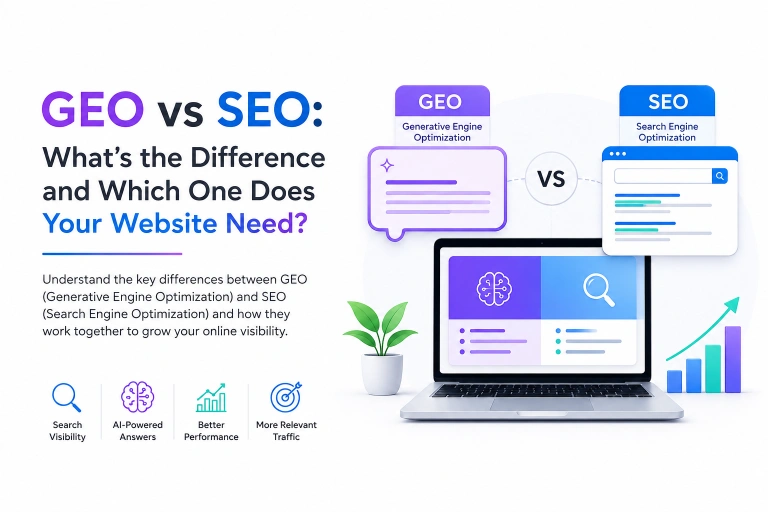
For years, getting noticed online was mainly about one thing: ranking higher on Google.
Businesses focused on keywords, backlinks, website optimization, technical SEO, and helpful content to bring more people to their websites.
But the way people search for information is changing.
Today, users are increasingly asking questions through AI-powered tools and getting direct answers instead of clicking through several search results. This shift has introduced another term into digital marketing: GEO, or Generative Engine Optimization.
So, what exactly is GEO? How is it different from SEO? And does your website really need both?
Let’s break down GEO vs SEO in simple terms and understand how these two approaches can work together.
What Is SEO?
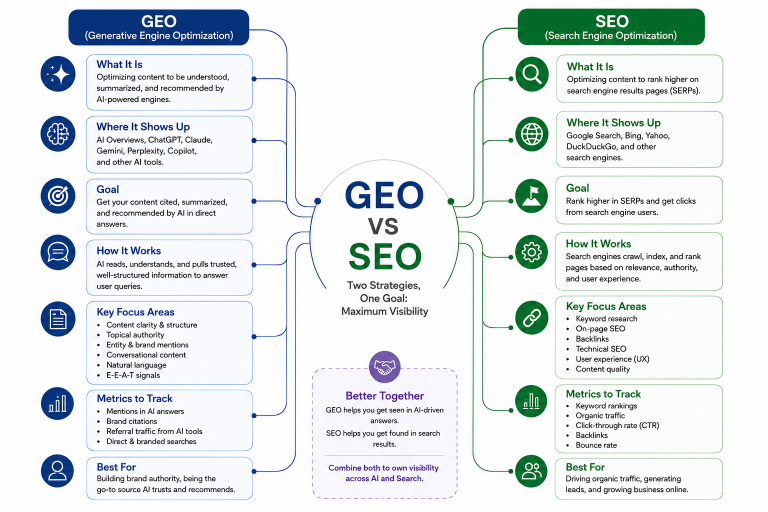
SEO (Search Engine Optimization) is the process of improving a website so that it can appear more prominently in search engine results.
For example, imagine someone searches for:
“Best digital marketing services for small businesses”
A business with relevant, useful, and well-optimized content has a better chance of appearing in organic search results.
SEO involves several important areas, including:
- Keyword research
- Search intent
- Helpful content
- On-page SEO
- Technical SEO
- Internal linking
- Backlinks
- Website speed
- Mobile usability
- User experience
Modern SEO isn’t simply about adding a keyword to a page repeatedly. Search engines increasingly focus on whether content is useful and relevant to the person searching.
You can learn more about search fundamentals through Google Search Central.
Why Is SEO Important?
A strong SEO strategy can help a business:
- Increase organic visibility
- Attract relevant website visitors
- Build online authority
- Generate leads
- Reach potential customers without paying for every click
- Build long-term online visibility
For most businesses that depend on online discovery, SEO is still an important part of digital marketing.
What Is GEO?
GEO stands for Generative Engine Optimization.
It refers to creating and structuring content with AI-powered search and answer experiences in mind.
Traditional search generally presents users with a list of links. AI-powered search experiences can instead provide a summarized response based on information gathered from different sources.
For example, someone might ask:
“What are the best digital marketing strategies for a small business?”
Instead of opening several websites and comparing information, the user may receive a summarized answer through an AI-powered tool.
GEO focuses on making your content clear, useful, relevant, trustworthy, and easy to understand so it can potentially be considered when AI systems generate answers.
However, there is an important point to remember: there is no guaranteed formula that makes a website appear in an AI-generated answer.
AI systems use their own processes, and these systems can change over time.
That means GEO should be viewed as an emerging part of modern search strategy, rather than a replacement for SEO.
For more information about AI technologies, you can also explore OpenAI.
GEO vs SEO: What’s the Difference?
SEO and GEO have a lot in common, but they focus on different search experiences.
| SEO | GEO |
|---|---|
| Focuses mainly on traditional search visibility | Focuses on AI-powered search and answer experiences |
| Targets search engine results | Considers AI-generated responses |
| Keywords and search intent are important | Clear, useful, answer-focused content is important |
| Technical SEO is important | Website quality and accessible information remain important |
| Backlinks and authority can support visibility | Relevance, context, and trustworthy information matter |
| Aims to attract organic search traffic | Aims to support AI-driven discovery |
The important thing to understand is that GEO and SEO are not opposites.
Many practices that make a website good for SEO can also make its content easier for AI systems and users to understand.
Is GEO Replacing SEO?
No.
This is probably the biggest question surrounding GEO.
People still use traditional search engines to discover businesses, products, services, and information. Your website still needs a strong foundation.
That includes:
- Helpful content
- Good website structure
- Fast-loading pages
- Mobile-friendly design
- Clear navigation
- Relevant internal links
- Strong topical relevance
- Good user experience
GEO is better understood as an adaptation to the changing search environment.
Think of it this way:
SEO helps your website become visible in search. GEO encourages you to create content that can also be useful in AI-generated answers.
You don’t necessarily have to choose one.
Can SEO and GEO Work Together?
Yes. In fact, for most businesses, this is probably the most practical approach.
Imagine you run a small digital marketing agency and publish an article called:
“10 Digital Marketing Strategies for Small Businesses.”
From an SEO perspective, you might:
- Research relevant keywords
- Understand search intent
- Create useful sections
- Optimize your title and headings
- Add internal links
- Improve the page experience
From a GEO perspective, you can also make sure the article:
- Answers common questions directly
- Uses clear headings
- Provides practical examples
- Explains concepts simply
- Includes original insights
- Supports important claims with reliable sources
- Covers the topic thoroughly
Notice the overlap?
Good content is still good content.
Instead of creating separate content for every new search trend, focus on creating genuinely useful resources that serve your audience.
How to Optimize Your Website for GEO
There isn’t a magic checklist that guarantees your content will appear in an AI-generated answer.
However, there are several sensible ways to make your content more useful, understandable, and discoverable.
1. Understand Your Audience’s Questions
Don’t focus only on individual keywords.
Think about the actual questions your customers ask.
For example, instead of targeting only:
“digital marketing services”
you could create content around questions such as:
- What does digital marketing include?
- How much does digital marketing cost?
- Which digital marketing strategy is best for a small business?
- How can a local business get more customers online?
These questions can become the foundation for useful blog posts, FAQs, guides, and service content.
2. Answer Questions Clearly
If someone asks, “What is GEO?”, don’t make them read 500 words before finding the answer.
Give them a clear explanation first and then provide examples and additional details.
Clear writing benefits both readers and your overall content strategy.
3. Build Topic Clusters
Instead of publishing one article about GEO and stopping there, build related content around the topic.
For example:
- What is GEO?
- GEO vs SEO
- How to optimize content for AI search
- GEO content strategy
- GEO for small businesses
- AI search and digital marketing
Connect relevant articles with internal links so readers can easily move from one topic to another.
You can also guide readers to other relevant resources on the BrightYou website.
A strong topic cluster can help create a more organized website and give readers a better learning experience.
4. Add Original Value
Don’t simply rewrite information that already exists on dozens of other websites.
Try adding something useful and original, such as:
- Your own examples
- Practical tips
- Comparisons
- Case studies
- Personal observations
- Real business scenarios
Before publishing, ask yourself:
“What will the reader actually learn from this article?”
That question can be more valuable than simply adding more keywords.
5. Use a Clear Content Structure
Make your content easy to scan and understand.
Use:
- H2 and H3 headings
- Short paragraphs
- Bullet points
- Tables where useful
- Examples
- FAQs
A clear structure helps readers find the information they need without feeling overwhelmed.
6. Don’t Forget SEO Fundamentals
While exploring GEO, don’t abandon traditional SEO.
Continue working on:
- Keyword research
- Search intent
- Technical SEO
- Internal linking
- Website speed
- Mobile usability
- Helpful content
- Page structure
In simple terms:
GEO should complement your SEO strategy, not replace it.
Google’s SEO Starter Guide is a useful resource for understanding SEO fundamentals.
GEO vs SEO: Which One Does Your Website Need?
For most businesses, the answer isn’t GEO or SEO.
It’s SEO + GEO thinking.
If you’re a small business, start by building a strong SEO foundation. Make sure your website clearly explains what you offer and answers the questions your customers are asking.
If you’re a blogger or content creator, focus on useful and original content instead of creating multiple articles simply to target different keywords.
If you’re running an e-commerce website, provide detailed product information, specifications, benefits, FAQs, and other information that helps customers make informed decisions.
And if you’re a digital marketer, you can start incorporating GEO principles into your existing SEO and content strategy as search continues to evolve.
What Does the Future of GEO and SEO Look Like?
Search is no longer limited to a simple list of blue links.
People discover information through Google, social media, videos, online communities, websites, and increasingly through AI-powered tools.
That means digital marketers need to think beyond:
“How do I rank for this keyword?”
A better question is:
“How can my brand become a useful and trustworthy source of information when people are looking for answers?”
That’s where SEO and GEO can work together.
SEO provides the foundation. GEO encourages marketers to think about how their content can remain useful as search experiences continue to change.
Frequently Asked Questions
Is GEO the same as SEO?
No. SEO focuses mainly on improving visibility in traditional search engines, while GEO focuses on creating content that can be useful in AI-powered search and answer experiences. There is significant overlap between the two.
Is GEO replacing SEO?
No. SEO remains important. GEO is an emerging approach that can complement traditional SEO as the way people search for information changes.
Which is better, GEO or SEO?
Neither is automatically better. For most businesses, maintaining strong SEO fundamentals while adapting content for changing search experiences is the more practical approach.
Does every website need GEO?
Not necessarily. However, businesses that depend on online visibility should pay attention to how people are increasingly discovering information through AI-powered tools.
How can I start with GEO?
Start with useful content. Answer relevant questions clearly, organize your information logically, build topical relevance, use trustworthy sources, and maintain a technically healthy website.
Can SEO and GEO be used together?
Yes. Many SEO and content practices can support both traditional search visibility and AI-powered discovery.
Final Thoughts
SEO isn’t disappearing. Search is evolving.
That doesn’t mean businesses should abandon SEO every time a new digital marketing trend appears.
Instead, focus on the fundamentals: create useful content, understand your audience, answer their questions, maintain a good website experience, and build authority around the topics you know.
Then start thinking about how that content can also be useful in AI-powered search experiences.
In simple terms:
SEO helps your website compete in traditional search. GEO helps you prepare for the changing ways people discover information.
So, when it comes to GEO vs SEO, the smartest strategy isn’t necessarily to choose one.
Build a strong SEO foundation, create genuinely useful content, and make that content clear enough to serve users across different search experiences.
Search will continue to change. Your content strategy should be ready to change with it.
Explore More From BrightYou
Want to learn more about AI search and digital marketing?
Explore more digital marketing resources on BrightYou and keep learning how SEO, AI, content, and digital marketing are shaping the future of online visibility.
BrightYou — Learn. Create. Grow.