
Meta Ads is changing.
For years, advertisers focused heavily on detailed targeting, interest selections, lookalike audiences, campaign structures, and manual optimisation. In 2026, Meta is moving further toward an AI-driven advertising system where the platform itself plays a much bigger role in deciding who sees your ads and when.
One of the technologies behind this shift is Meta Andromeda.
But what exactly is Andromeda, and what does it mean for businesses and marketers running Facebook and Instagram ads?
Let’s make it simple.
What Is Meta Andromeda?
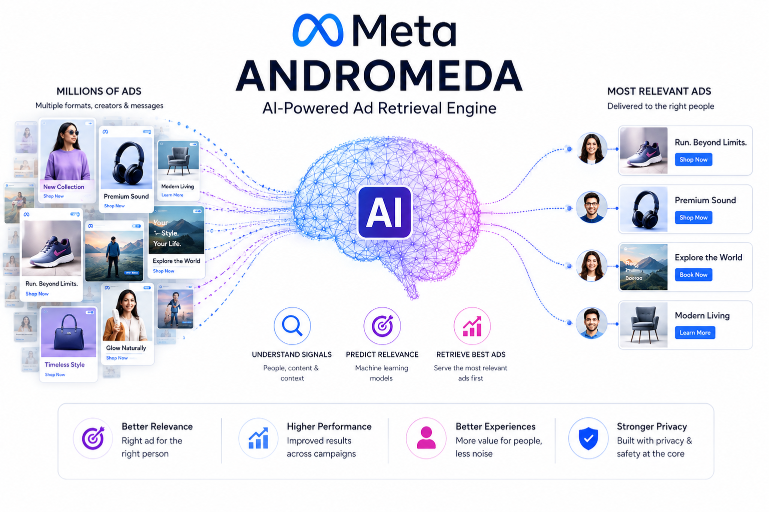
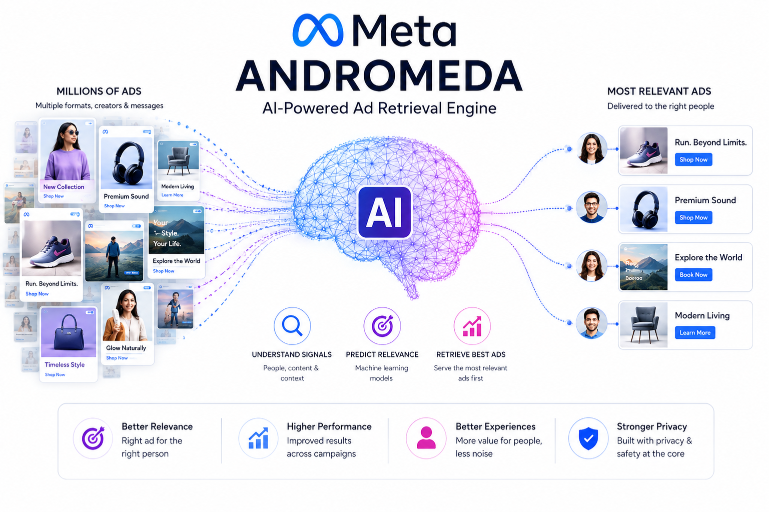
Meta Andromeda is an AI-powered ads retrieval system developed by Meta.
Before an ad is shown, Meta has to process an enormous number of possible ads. Andromeda helps the platform quickly identify the most relevant ad candidates for a particular person before later systems rank and decide which ads are ultimately shown.
According to Meta’s engineering team, Andromeda uses advanced machine learning and deep neural networks to improve personalisation and handle the growing number of ad creatives in Meta’s advertising ecosystem.
In simple terms:
Andromeda helps Meta find better potential ads for the right people at a massive scale.
This is important because advertisers are now creating more variations of ads, especially with AI-powered creative tools and Advantage+ automation.
Why Is Meta Moving Toward AI-Driven Advertising?
Meta has access to huge amounts of signals related to how people interact with content, products, businesses and advertisements.
However, traditional advertising systems had limitations.
Earlier strategies often depended heavily on:
- Manual audience targeting
- Interest selections
- Lookalike audiences
- Complex campaign structures
- Rules created by advertisers
AI-driven systems can analyse more signals and identify patterns at a much larger scale.
Meta has continued investing heavily in AI systems across its advertising infrastructure, including more advanced retrieval and ranking models. In 2026, Meta described further improvements to its ads recommendation technology, showing how AI is becoming increasingly central to ad delivery.
This does not mean targeting is completely irrelevant.
It means the balance is changing.
Instead of trying to control every detail manually, advertisers increasingly need to provide Meta with:
- Strong creative
- Clear conversion signals
- Enough variation to learn from
- Accurate tracking
- A clear campaign objective
How Meta Andromeda Can Affect Your Meta Ads
1. Creative Is Becoming More Important
One of the biggest changes is the growing importance of ad creative.
Your image, video, headline, hook and message can all provide signals that help Meta understand what your ad is about and who may respond to it.
For example, imagine a skincare brand creates these ads:
- One ad focused on dry skin
- One ad focused on natural ingredients
- One ad focused on sensitive skin
- One video showing the product being used
These creative variations can give Meta more options to match with different people.
Instead of creating 10 nearly identical ads, it is better to test different ideas and angles.
2. Broad Targeting Can Become More Useful
Many advertisers previously relied heavily on highly detailed interest targeting.
But as Meta’s AI systems improve, overly restrictive targeting can sometimes limit the system.
Broad targeting gives Meta more room to identify potential customers.
For example:
Old approach:
Women → Age 25–34 → Beauty → Skincare → Online Shopping → Specific interests
AI-driven approach:
Relevant location + basic business requirements + strong creative + optimisation data
The AI system can then use available signals to find people who are more likely to take the desired action.
This does not mean every business should automatically remove all targeting restrictions. Testing is still important.
But the focus is shifting from:
“Can I manually find the perfect audience?”
to:
“Can I give Meta enough strong signals to find the right audience?”
3. More Creative Variations Matter
Meta’s systems are designed to handle a growing volume of ad creatives. Meta has specifically explained that Andromeda was developed to support the increasing number of creative variations generated through automation and AI tools.
This means advertisers should think beyond simply changing a headline.
Test genuinely different concepts.
For example:
Creative Concept 1: Problem
“Still struggling to get customers online?”
Creative Concept 2: Result
“Turn your website visitors into real leads.”
Creative Concept 3: Educational
“3 digital marketing mistakes small businesses make.”
Creative Concept 4: Social Proof
“See how businesses are improving their online presence.”
Each concept communicates something different.
That gives the advertising system more meaningful creative options to work with.
Traditional Meta Ads vs AI-Driven Meta Ads
| Traditional Approach | AI-Driven Approach |
|---|---|
| Heavy manual targeting | More automated audience discovery |
| Many ad sets | Simpler campaign structures |
| Small creative changes | Different creative concepts |
| Manual optimisation | AI-assisted optimisation |
| Focus on interests | Focus on signals and outcomes |
| Strict audience control | More flexibility for the system |
The goal is not to completely abandon strategy.
The goal is to spend less time fighting the algorithm and more time giving it useful inputs.
How Should You Optimise Creative for Meta Andromeda?
Here are five practical strategies.
1. Create Different Concepts
Don’t simply create five versions of the same poster.
Test different approaches:
- Problem-solving
- Educational
- Testimonial
- Product demonstration
- Before and after
- Founder story
- Offer-focused
- Emotional storytelling
Different concepts can appeal to different people.
2. Improve Your First Few Seconds
For video ads, the opening is critical.
Ask:
- Does the video grab attention quickly?
- Is the problem clear?
- Is the product visible?
- Would someone understand the message without sound?
Avoid long introductions.
Get to the point.
3. Use Multiple Formats
Don’t rely on only one image size or format.
Consider testing:
- Short videos
- Static images
- Carousels
- Reels-style videos
- Product demonstrations
- Customer testimonials
The goal is to discover what message and format work best.
4. Focus on Clear Messaging
Your creative should answer:
- What is this?
- Who is it for?
- Why should I care?
- What should I do next?
A confusing ad makes it harder for people to understand your offer.
Simple messaging usually performs better than trying to communicate everything at once.
5. Give Campaigns Enough Time to Learn
Constantly editing campaigns can interrupt the learning process.
Avoid changing:
- Budget
- Audience
- Creative
- Optimisation events
every few hours.
Instead, allow campaigns enough time and data before making major decisions.
Common Mistakes Businesses Should Avoid
Creating Too Many Ad Sets
A complicated campaign structure can split your budget and data.
Instead of creating many tiny audiences, consider whether a simpler structure can provide better learning.
Using Nearly Identical Creatives
Changing only the colour of a poster is not a meaningful creative test.
Test:
- Different hooks
- Different offers
- Different problems
- Different visuals
- Different customer motivations
Changing Campaigns Too Quickly
Performance can fluctuate.
Don’t panic because one day looks worse than the previous day.
Look for patterns over a meaningful period.
Ignoring Tracking
AI is only as useful as the signals it receives.
Make sure your tracking setup is working properly.
For lead generation, purchases or other conversions, accurate event tracking helps Meta understand what success looks like.
What Should Businesses Do in 2026?
Here is a simple strategy:
Step 1: Simplify Your Campaign Structure
Avoid unnecessary complexity.
Step 2: Use Clear Conversion Goals
Tell Meta what you want:
- Leads
- Purchases
- Website conversions
- App installs
Step 3: Invest More in Creative
Creative testing is becoming one of the biggest competitive advantages.
Step 4: Test Different Ideas
Don’t only test different designs.
Test different messages and concepts.
Step 5: Improve Your Website and Landing Page
Getting the click is only half the job.
Your landing page should:
- Load quickly
- Explain the offer clearly
- Work well on mobile
- Have a clear call to action
Step 6: Measure Results Properly
Track the metrics that actually matter to your business.
Depending on your goal, this could include:
- Cost per lead
- Cost per purchase
- Conversion rate
- Return on ad spend
- Revenue
Is Meta Andromeda Replacing Advertisers?
No.
Meta’s AI can help with automation and ad delivery, but businesses still need strong strategy.
You still need to understand:
- Your customers
- Their problems
- Your offer
- Your brand
- Your creative message
- Your business goals
AI can optimise delivery.
It cannot automatically create a great business strategy from nothing.
The best results usually come from combining:
Human strategy + strong creative + accurate data + AI optimisation
Frequently Asked Questions
What is Meta Andromeda?
Meta Andromeda is Meta’s AI-powered ads retrieval system that helps identify relevant ad candidates from a very large pool before later ranking systems determine which ads are shown.
Does Meta Andromeda mean detailed targeting is dead?
No. Targeting still has a role, but Meta’s AI systems are becoming more capable of finding potential customers using broader signals and automation.
Should I use broad targeting?
Broad targeting can be worth testing, especially when you have strong creative and reliable conversion tracking. Results will depend on your business, market and campaign objective.
Does Andromeda make creative more important?
Creative has become increasingly important because different creative concepts give Meta more information and more opportunities to match ads with relevant people.
Will Meta Ads become fully automated?
Automation is increasing, but advertisers still need to provide strategy, creative direction, offers, tracking and business goals.
Final Thoughts
Meta Andromeda represents a major shift in how Meta approaches advertising.
The future of Meta Ads is moving away from manually controlling every small detail and toward providing powerful systems with better inputs.
For businesses, the message is clear:
Stop relying only on targeting tricks.
Focus on:
- Better creative
- Clear messaging
- Strong offers
- Accurate tracking
- Meaningful creative testing
- Simple campaign structures
In 2026, successful Meta advertisers will not necessarily be the people who create the most complicated campaigns.
They will be the people who understand their customers, create strong content and give Meta’s AI the right signals to work with.
Sources and Further Reading
- Meta Engineering: Meta Andromeda and personalized ads retrieval
- Meta Engineering: Meta Adaptive Ranking Model
- Meta Engineering: GEM Training and Ads AI Infrastructure
- Meta Engineering: Modernizing the Meta Ads Service
Suggested focus keyword: Meta Andromeda
Suggested SEO title: Meta Andromeda Explained: How It Is Changing Meta Ads in 2026
Suggested slug: meta-andromeda-meta-ads-2026
Suggested meta description: Learn what Meta Andromeda is, how Meta’s AI-powered ad system works, and how it is changing creative, targeting and Meta Ads strategy in 2026.